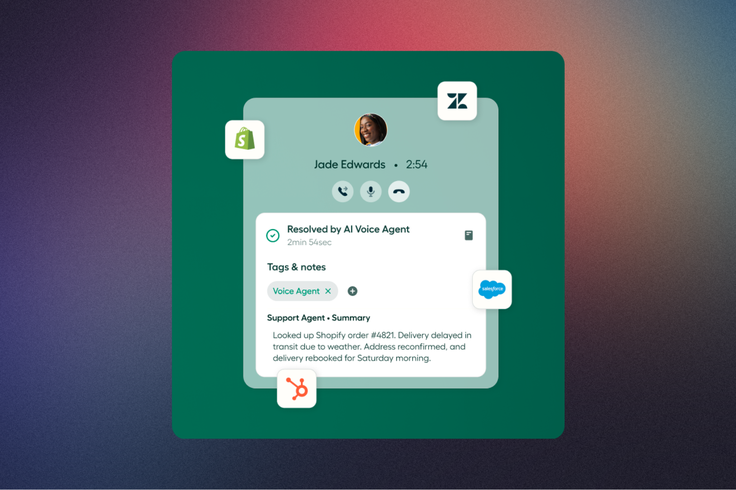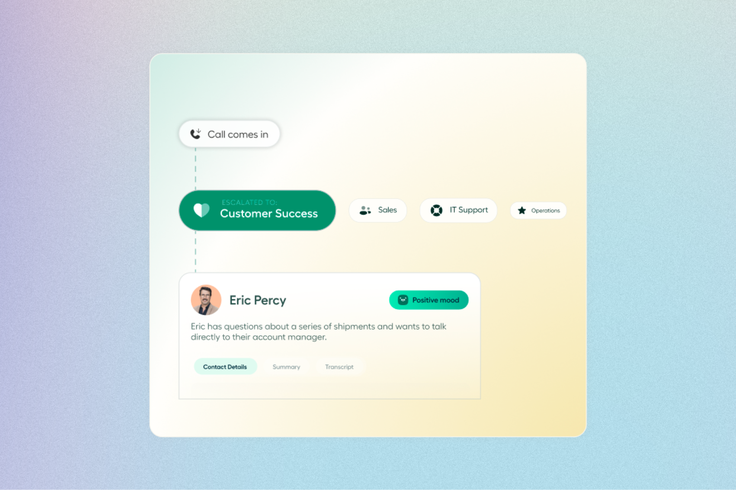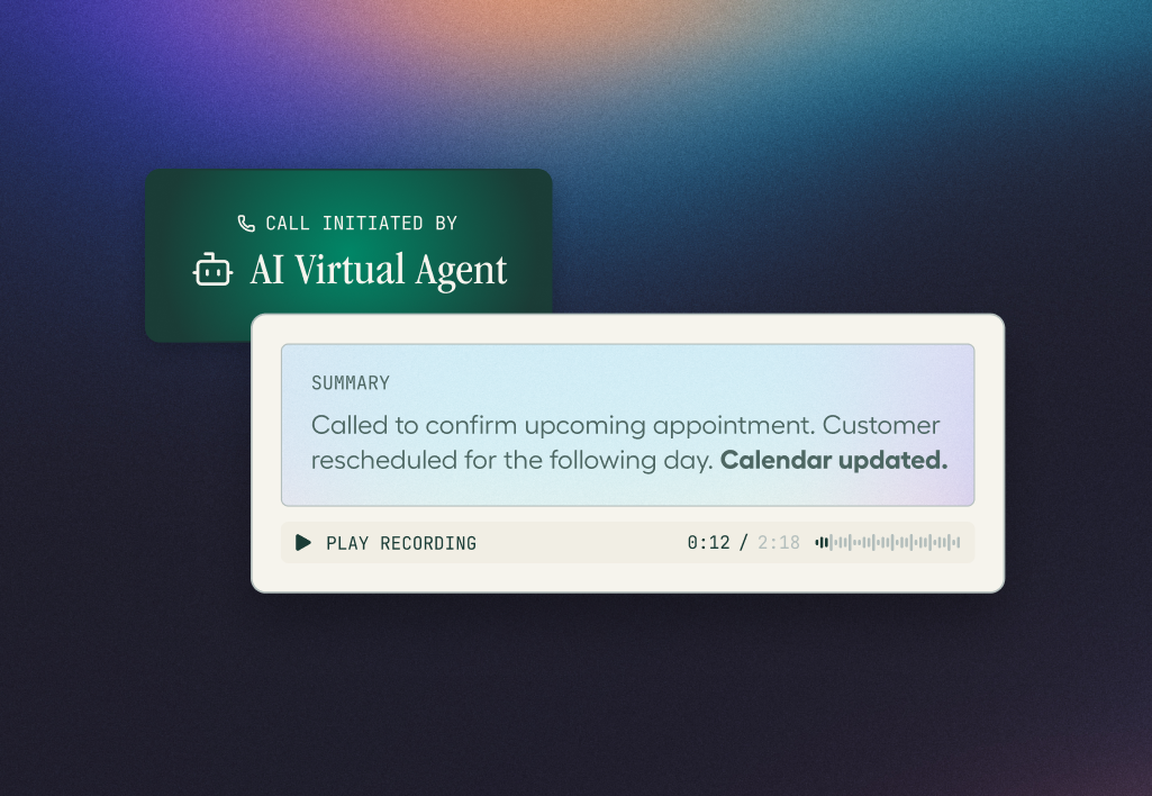
TL;DR. An AI voice agent for customer support answers inbound calls autonomously, understands natural speech, resolves routine queries without a person, and hands complex calls to a teammate with full context. Aircall's AI Agent is built into the phone system rather than bolted on through a third-party API, so escalation carries the full transcript and every call logs to the CRM automatically. It fits teams whose inbound volume contains a large share of repetitive, low-complexity calls, and it is different from chat-first AI tools like Intercom Fin and Zendesk AI, which resolve text conversations rather than real-time phone calls.
Key takeaways
An AI voice agent handles routine support calls autonomously by understanding natural speech, not keypad menus.
The difference from an IVR is intent understanding. The difference from chat-first AI such as Intercom Fin and Zendesk AI is that an AI voice agent resolves live phone calls, not asynchronous text.
Voice-native design is the point: escalation to a person carries full context and every call logs to the CRM automatically, because the AI Agent lives inside the phone system rather than connecting through an API.
Fit depends on call profile, not team size. Teams win when a meaningful share of inbound calls follow the same resolution path.
Aircall's AI Agent resolves up to 40% of routine tier-1 calls autonomously. Gartner projects agentic AI will resolve 80% of common service issues by 2029.
Published on .
Ready to build better conversations?
Simple to set up. Easy to use. Powerful integrations.
Get free access